
Introducing Kai: The Smarter Way to Manage Shared Assets

If you've ever co-owned anything (a yacht with cousins, a plane with a flying club, a holiday house with friends), you know the funny part: the asset is the easy bit. It's everything around it that gets weird. Who's taking it next weekend? Who paid for the last service? Why is the fuel gauge always pointing at empty when it's finally your turn?
We started Kai because we'd lived through enough of those conversations to know they don't get easier with time. They get awkward. Then they get expensive. And eventually, for a lot of groups, they end the arrangement, even when the asset itself was working out fine.
What we kept hearing
Over the past year we sat down with dozens of co-owners. Flying clubs, yacht partnerships, families with a shared cabin, three friends with one car. Different assets, same problems on repeat. Booking lived in a WhatsApp thread that nobody could scroll back through. Expenses lived in a spreadsheet that one person updated and everyone else trusted. Maintenance lived in someone's head until something broke. Money conversations were either avoided entirely or resented quietly. None of those things are catastrophic on their own. They're just the slow drip that turns shared ownership from a great idea into a chore.
What Kai actually does
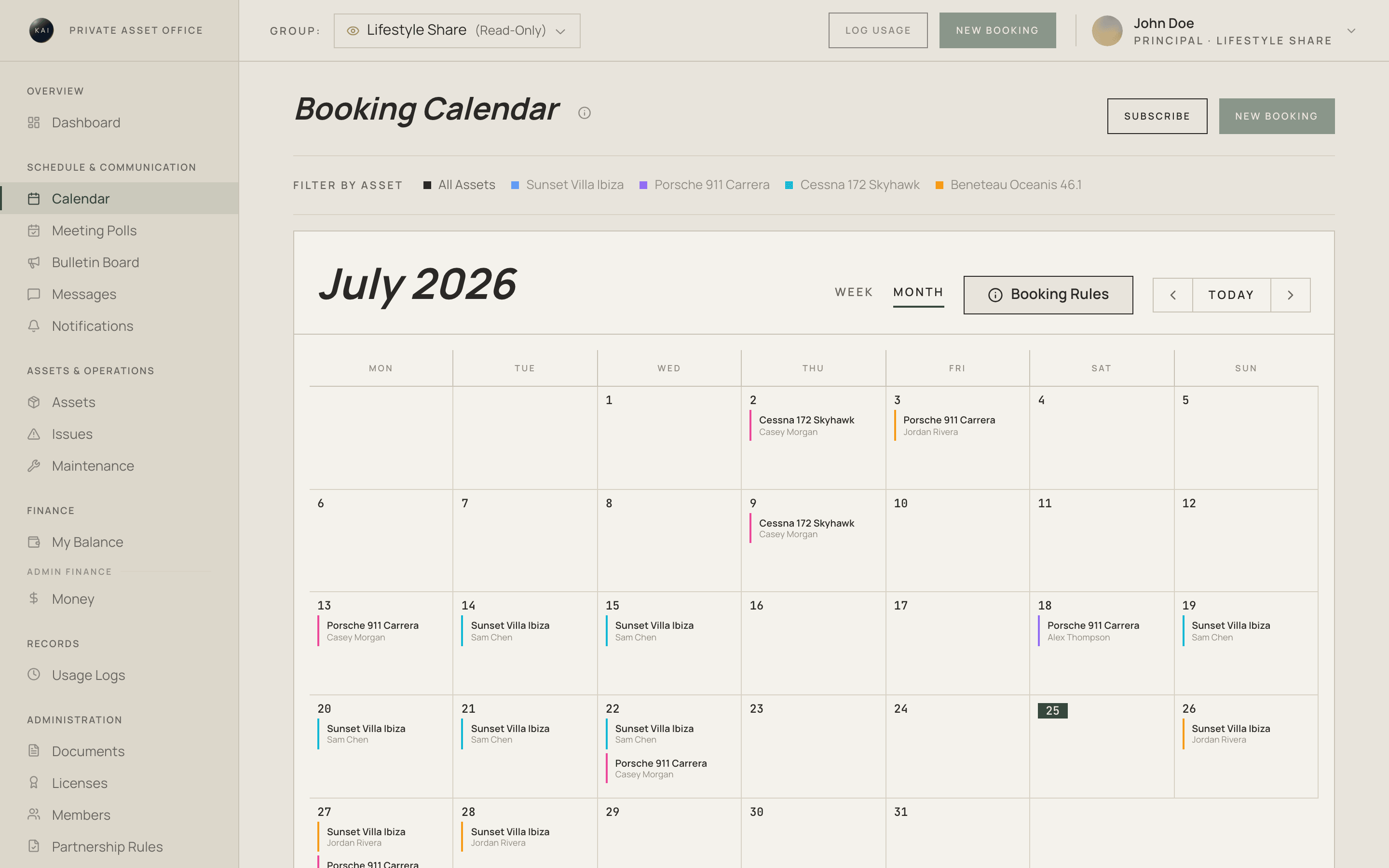
The first thing most groups notice is the calendar. It's a real shared calendar, not a chat thread, and you can shape it to your group's idea of fair: quotas, weekend caps, blocked-off time, limits on how many consecutive weekends one person can book. Whatever your version of fairness looks like, you can encode it instead of arguing about it.
Expenses work the way the conversation should. Someone fills up the tank, snaps a photo of the receipt, picks how it splits, done. Everyone sees what they owe and what they're owed in real time. Nobody has to be the treasurer, and nobody has to chase anyone for €40.
Maintenance is the part most groups underestimate until they're stuck. Kai tracks usage hours, logs inspection history, and reminds the right person before the next service is due, so the person flying on Saturday morning isn't also the one who discovers, mid-preflight, that the 100-hour inspection went overdue last Tuesday.
And because most of the friction in co-ownership is communication, not coordination, we kept asset-related conversations in the same place as the calendar and the costs. Not scattered across three apps and a group chat someone muted last March.
What's here now
Since we first wrote this, most of that early roadmap has shipped. Kai is on iOS and Android, alongside the web app. Accounting integrations connect your group's invoices to Yuki, Moneybird, Exact Online, e-Boekhouden, and Informer. White-label and custom branding are available on higher plans for clubs that want Kai under their own name. There's an in-app AI assistant, also named Kai (currently in beta), and API and MCP access as an add-on for groups that want to build on their own data. What comes next will keep being shaped by groups telling us where the system still feels clunky. That's been true of almost every feature we've shipped so far.
If you want to see how it feels, the easiest thing is to poke around one of the demo groups: no setup, no card, just the product. And if there's something specific you're trying to solve, write to us. The early conversations have shaped most of what Kai is.